Our Notes & References
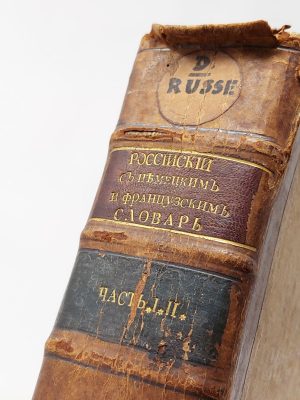
First foreign translation of Lomonosov’s seminal Russian grammar, which codified the rules of the modern Russian language.
Very rare, with the last and only copy we could find at auction being sold in 1986. We could trace only one example in America (Yale) and only 5 elsewhere: BL, 2 in Germany (Marburg and BSB in Munich), Lyon and one in St. Petersburg (NLR) – apparently none in the Moscow State Library.
Although he had been an Adjunct of the Russian Academy of Science since 1742, the Russian polymath, scientist and writer Mikhail Lomonosov (1711-65) was in almost constant conflict with the other members, largely because he “sensed his superiority over the majority of them” (Menshutkin, 40).
This was the direct cause of the delay in the appearance of this German translation of his Grammar — although it had been ordered contemporaneously with its first publication in 1755, the academic assigned to translate it, Johann Lorenz Stavenhagen (1728-84), the archivist of the Academy, was an intellectual opponent of Lomonosov’s and actively avoided completing the assignment through “passive resistance and delaying tactics” (Heller).
Although grammars of Church Slavonic had already been in circulation for centuries, it was thought that the vernacular Russian language was merely an “imperfect copy” and therefore unworthy of study (Okabe, 121). Russian in the 18th century was an “indiscriminate and arbitrary mixture of vocabulary and grammatical forms”, with continuous argument between major literary figures as to what its ideal character should be (Zingg, 56).
Lomonosov single-handedly resolved the issue in this Grammar, virtually creating the modern Russian literary language by reconciling it with its Slavonic sister. Drawing on Classical and German influences (he had attended the Universities of Marburg and Freiberg), Lomonosov proposed a division of Russian into high, middle and low registers and tackled the problem of the classification of Russian verbs by creating a novel ten-fold system. The Grammar also forever changed the way Russian was spoken — Lomonosov decided that the Moscow dialect should be the base for the phonetic system of the entire empire, which is why the language has so much akane (pronouncing unstressed O as A). He also disliked the foreign words which had crept in following Peter the Great’s reforms and coined many Russian neologisms to replace them (see Zingg, 43 and 54).
Pushkin was greatly inspired by Lomonosov and, although he relaxed many of the latter’s grammatical rules, commented extensively on his poetic works and praised him effusively: “Lomonosov embraced all the branches of knowledge… between Peter I and Catherine II he stands alone as a pioneer of enlightenment (prosveshchenie)” (Usitalo pp. 156 and 162).”
It is worth emphasising how important the German language was in 18th-c. educated Russia, a fact well witnessed by the decision to have a German version of Lomonosov’s grammar as soon as it was published. Besides, the edition is dedicated by Stavenhagen to Pavel Petrovich, the future Tsar Paul 1, then about 10-y old and himself having much German blood, with his mother Sophia von Anhalt-Zerbst habing been for two years on the Russian throne as Catherine II.
Provenance
J. J. Krohn (black ink stamp to title); private Danish collection.
Bibliography
Cat. Russica L-1123 (“Grammatik”); Daintith, John, and Derek Gjertsen. 1999. A Dictionary of Scientists. Oxford University Press; Heller, Wolfgang. 1990. ‘Kooperation Und Konfrontation M. V. Lomonosov Und Die Russische Wissenschaft Im 18. Jahrhundert’. Jahrbücher Für Geschichte Osteuropas 38 (1): 1–24; Menshutkin, B. N. 1952. Russia’s Lomonosov;: Chemist, Courtier, Physicist, Poet,. Princeton University Press; Okabe, Shoichi. 1985. ‘Russian Grammars before Lomonosov’. In Kanazawadaigaku bungakubu ronshū. Bungakka-hen, vol. 5. 1985-02-25; Usitalo, Steven. 2013. The Invention of Mikhail Lomonosov: A Russian National Myth. Academic Studies Press; Zingg, Olgica. 1997. MA Thesis, ‘The role of Lomonosov in the formation of the early modern Russian literary language’. Austin. McGill University.
Physical Description
Octavo (19.5 x 12.5 cm). Title, [8] dedication, 380 and [3] pp., with quire S with wrong pagination as usual.
Binding
Contemporary vellum, flat spine with hand-written author and title, marbled edges, green silk bookmark.
Condition
Binding soiled with a few spots, tear to upper edge of upper cover with minor loss; some leaves a bit browned, a bit of spotting throughout, mostly marginal, title with small illegible inscription in brown ink.