Our Notes & References
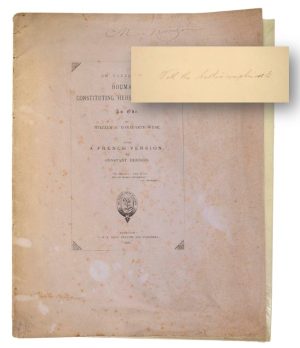
Very rare pre-publication version of this detailed set of regulations, one of the “authentic copies” signed twice by the negotiating parties, this one coming from a member of the team at work.
Following the Russo-Turkish War of 1877–1878 and the Treaty of Berlin (July 1, 1878), Bulgaria was divided into three parts, one of which was Eastern Rumelia. Although autonomous, it remained under the Ottoman Sultan’s authority, but was governed by a Christian governor-general. The specifics of this subordination, along with the administrative, judicial, and financial structures of the province, were defined by an international commission of the Great Powers (Germany, Austria, France, the United Kingdom, Italy, and Russia) and the Ottoman Empire. Between September 1878 and April 1879, the Commission drafted the Statut Organique de la Roumelie Orientale, consisting of 15 chapters and 495 articles, plus 13 annexes with 637 articles.
After the Commissioners voted definitively on the statute, “they signed and sealed with their arms the official document of this Act and its Annexes, as well as six authentic copies of the same Act and its Annexes. The official document shall remain deposited in the archives of the Sublime Porte; the six copies shall be delivered by the Bureau to the Commissioners of the other Powers” (64. Protokoll der Ost-rumelischen Kommission, Nr. 7064). A fully printed version was then published, without authentic signatures but mentioning the signatories, including three who certified that copies and publications were an exact match to the original (“certifié conforme à l’original”).
This signed copy belonged to one of the three gentlemen who confirmed the exact match: the Chevalier E. Curiel, an attaché to the Italian diplomatic mission in Constantinople, who became the Secretary of the Finance Committee attached to the Commission which negotiated and drafted the Statut.
Of great rarity. The only other copy with signatures which we could find is in Princeton, but it is signed only once, as it is missing about half the book, the (signed) Annexes present here (pp. 113-228). It came from the British Commissioner H. Drummond Wolff. Princeton also owns a complete copy of the regular edition, published only with the printed names.
We could not trace any example at auction in recent decades (signed or not); WorldCat locates a few holdings, without mentioning any signature (McGill, Univ. of Minnesota, Rice – as well as Oxford, BL, Institut français d’études byzantines, Univ. Leipzig, and Staatsbibliothek zu Berlin), to which we can add copies at LoC, Ghent University, Baskent University (Turkey), and Sofia University.
The negotiated statute was fundamental to “determine the future development of the province of Eastern Rumelia” (Vasileva). It stated that a governor-general was to be appointed for five years by the Turkish Sultan with the consent of the Great Powers. He would govern with the help of five directors and chiefs of militia and gendarmerie, while the Regional Assembly served as the legislative body. It also guaranteed private property rights, freedom of speech, religion, and the press. The statute detailed the militia’s structure, including tables for battalion composition, and in the second part titled “Annexes”, it outlined more specific regulations, such as those on treatment of sick prisoners and salaries of different military ranks.
Signed in Istanbul on April 14/26, 1879, the statute led to the appointment of the first governor-general, Bulgarian Prince Alexander Bogoridi (1879–84).
Voting for each article of the statute proved to be a struggle: dissatisfied with the Treaty of Berlin, the Russian side was reluctant to make concessions and “most of the time […] opposed the projects [… and actively] exercised the right of veto […] even against the united decision of the representatives of all of the six Powers” (Vasileva). Leading this opposition was the Russian consul-general in Eastern Rumelia, Aleksei Nikolaevich Tsereteli (also Tseretelev, 1848-83), a hereditary Georgian prince and cousin of poet Akaki Tsereteli. His main opponent in the Commission was Sir Henry Drummond Wolff (1830–1908), a British MP.
Both Tseretelev and Wolff signed the copies of the Statut, including ours. The other signing Commissioners were the Austro-Hungarian commissioner Benjamin Kallay (1839-1903), a Hungarian nobleman and Chamberlain to His Imperial and Royal Apostolic Majesty, in his later career he “was concurrently imperial minister of finance and chief secretary for Bosnia for more than two decades (1882–1903)” (Britannica); the French commissioner Baron Maximilien Napoléon de Ring (1868-1903), and the Deputy Commissioner Gustave de Coutouly de Dorset (1838-1907); the German vice-consul Ernst von Braunschweig (1845-1907); the chief translator to the Italian Embassy at Constantinople, Chevalier Alessandro Vernoni (c. 1825-89); and the Turkish representatives “Son Excellence Assim-Pacha [(1813-83)], Muchir, Sénateur de l’Empire” and Abro-Effendi, “Fonctionnaire de Premier Rang, Directeur du Contentieux au Ministère des Affaires Étrangères Ottoman”.
During the drafting of the statute, the Commissioners were assisted by three secretaries: M. Rozet, attaché to the French embassy; Aleksandr Isvolsky, secretary to the Russian consul-general in Philippopolis; and the Turkish representative, Selim Efendi. The Commission soon appointed three members to the Finance Committee: M. de Coutouly, Lord Donoughmore, and Abro Effendi. De Coutouly introduced Curiel to be the Committee’s secretary.
Eastern Rumelia ceased to exist when it was united with the Bulgarian Principality in 1885.
Provenance
E. Curiel (name lettered in gilt to upper board).
Bibliography
Correspondence respecting the proceedings of the European commission for the organization of Eastern Roumelia ; presented to both houses of Parliament by command of Her Majesty, Harrison and Sons, London, 1879.
Das Staatsarchiv. Sammlung der officiellen Actenstücke zur Geschichte der Gegenwart, Vol. 36, // “Nr. 7064 […] 64. Protokoll der Ost-rumelischen Kommission”, Leipzig, Kremer-Auenrode und Ph. Hirsch, 1880, p. 297.
Entsiklopedicheskii slovar Brokgauza i Efrona, “Bolgariia”, t. IV, 1891.
Medlicott, W. N., and Richard G. Weeks. “Documents on Russian Foreign Policy, 1878-1880: Section II: January-February 1879.” The Slavonic and East European Review, vol. 64, no. 2, 1986, pp. 237–55.
The Editors of Encyclopaedia Britannica, “Benjamin Kállay”, Encyclopaedia Britannica.
Vasileva, Nadezhda. “Russia, Britain and the Establishment of the Province of Eastern Rumelia”, Vakanüvis – Uluslararası Tarih Araştırmaları Dergisi, 2018, pp. 449-467, Issue 3.
Physical Description
Large 8vo (31 x 21.5 cm). 228 pp. including title.
Binding
Contemporary brown morocco, gilt ornamental frames on boards with blind stamped fleurons in corners, gilt lettering to upper cover, flat spine with gilt and blind fillets, salmon endpapers.
Condition
Light marks to lower cover, lower endpapers browned at edges; occasional light foxing or staining – an attractive example, in fresh condition.