Our Notes & References
First and most likely only Russian edition of this satire challenging the authority of academia and showing the uneasy fate of scholars.
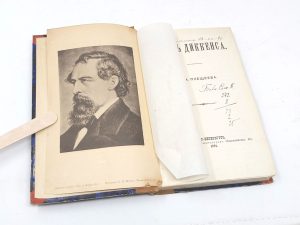
A lovely example, fresh, in a Russian binding with an elegant, decorative and slightly unusual spine.
Very rare outside Russia, as we couldn’t trace any example in public libraries, nor at auction in recent decades.
This satirico-moral tale, whose title means ‘The Man with Latin, or the Destiny of the Learned. An Improbable Story’ was first published in 1769 in Geneva, a relatively safe haven for such publications. A work by the French philologist Pierre Louis Siret (1745-98), it was actually attributed for some time to Voltaire, for its wit and harsh criticism of the current state of affairs of intellectual and cultural elites in Europe. This attribution is visible here, with ‘Volter’ lettered in gilt on the spine.
The story reflects the challenges and ironic or paradoxical aspects of a life dedicated to intellectual pursuits. It follows the adventures of a young man named Xanxgung, whose father dreamed of making him a learned man and joining the nobility. The young man diligently studied “Latino-Greco-Topo-Geo-Hydro-Physico-Cosmo-Astro-Historicology”, became expert in ancient languages and history, and gradually grew arrogant, vain, and ashamed of his uneducated father.
Xanxgung left for London to pursue a brilliant career as he believed he had reached the highest degree of perfection. When confronted with reality, he discovered that he had no practical knowledge and could not find a job. As soon as he achieved some success publishing popular philosophical leaflets, he ended up in jail for criticising the crown. Several more ups and downs, escapes and betrayals, attempts to change careers and to become an opera singer or a sham art expert, and the protagonist laments that if he had never known any sciences, none of these misfortunes would have happened to him. He grows terrified with corruption, hypocrisy and lies of scholars who deliberately study made-up sources and flatter their patrons to make a living. Eventually, Xanxgung reconciles with his father, returns to his hometown and creates a small community of learned people for the better of his country.
This Russian translation remained anonymous. It was published by the largest and arguably most interesting book-printing enterprise in Russia at that time, run by Nikolai Novikov, an educator, freemason and one of the major figures of the Enlightenment in Russia. Before suffering from Catherine the Great’s change of attitude, Novikov’s publishing house translated and disseminated various European novels, works of philosophy and sciences, and greatly influenced Russian literature: “Novikov’s printing activities helped to nurture and grow a large number of Russian writers, including such remarkable talents as Fonvizin, Radishchev and Karamzin” (Svetlov, our translation).
Bibliography
Svod. Kat. 6481; Svetlov, Izdatelskaia deiatelnost N. I. Novikova, Gizlegprom, 1946.
Physical Description
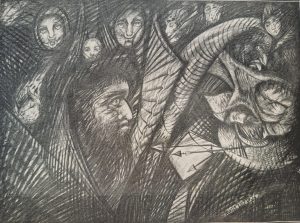
Octavo (16 x 9.3 cm). Half-title, title with censor’s note and Novikov’s mark on verso, [4] pp. t.o.c. and 136 pp., with a figurative wooduct headpiece.
Binding
Contemporary Russian brown half calf over marbled boards, flat spine with finely gilt and blind-stamped decorations, direct gilt lettering, blue speckled edges.
Condition
Hinges lightly restored, spine ends a bit rubbed; minimal light staining on title, otherwise fresh, an attractive copy.