Our Notes & References
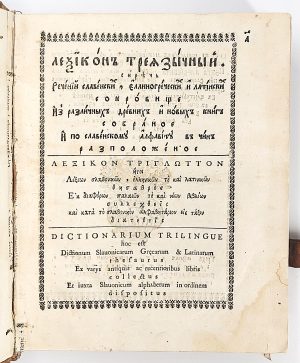
First edition of the first dictionary ever printed in Russia: one of the first Russian secular books, and one of the great achievements of the printing press under Peter the Great, by “a brilliant representant of Russian intellectuals of the new era” (Ziborov).
This is also the second book printed in Greek or Latin in Moscow’s unique publishing house (and Russia’s first), just three years after the first, also due to Polikarpov. This Leksikon was intended as a natural complement to the 1701 Bukvar, a primer trilingual in the same manner. Fonts were specially cut for them, as the use of foreign fonts was extremely limited in the Russian capital, and both works became part of the first entreprise in Russia to teach three languages at the same time. Incidentally they also opened the world to the Russian language, helping its translation and recognition (see Ziborov).
The longer Introduction of the work, only in Slavonic, is of particular importance thanks to the various themes which Polikarpov develops. He justifies the use of these specific languages: Slavonic is praised for its purity and beauty, as ‘mother’ of many other languages, and therefore worth of the position usually occupied by Hebrew in tri-lingual dictionaries; Greek is the language of ancient knowledge and the source of Orthodoxy; and Latin, the language most common in studies and civil matters “all over the world” (Stroev p. 421). Ziborov interestingly notes here that Latin isn’t associated anymore with the schismatic Catholics.
“In so many words did Polikarpov recognize the gathering force in Russia of cultural Europeanization under Peter I” (Cracraft).
The Introduction – sometimes confused with the preface, much shorter, and trilingual – is also famous for witnessing an effort to bring texts to simple and poorly educated readers. The dictionary was however compiled predominantly for the use of the first higher education establishment in Moscow, the Slavic Greek Latin Academy, where Polikarpov (c.1670-1731) studied 9 years. Founded in 1682, it was under the supervision of Joannicus and Sophronius Likhud, two brothers of Greek origins, from 1687 to 1694, at which point Polikarpov became a teacher there. The preface of the Leksikon mentions that the Likhud brothers reviewed the work. In 1701, Peter the Great turned it into a state academy.
“Polikarpov’s dictionary draws on translational traditions of the second half of the seventeenth century, especially on those of the Greco-Slavonic school in which Polikarpov was raised up as a scholar…Polikarpov’s goal in compiling the dictionary was educating younger generations (1704: 4: “[so that] the understanding of the youth multiply and thrive”)” (Tiulenev p. 111).
The dictionary, with almost 20,000 entries sometimes commented, carries also important evidences of the Russian language of the time. It includes several words from the common language, which probably wouldn’t have been printed a few years later, such as nineteen (!) words with the root ‘blya’ (an obscene term in today’s Russian), while the group of words with the root ‘blud’ (fornication) provides us with an interesting overview of Russian lexicography on that topic.
The entries “are notable (1) for the large number of loanwords simply transliterated into Cyrillic; (2) for the numerous ecclesiastical terms…and the otherwise esoteric or “medieval” character of many of the remaining entries (for instance, Alkhimia…alchymia, scientia docens facere aurum); and (3) for the occasional appearance of the “simple vernacular” equivalent after the Slavonic headword…, thus acknowledging the existence of two distinct languages in Russia” (Cracraft; for more details on the contents, see Fryscak).
Established in the 1550s, Russia’s first state typography Pechatnyi Dvor had the monopoly for printing books in Moscow up to the beginning of the eighteenth century. From 1701 to his death 30 years later, Polikarpov directed the publishing house (with a small interruption in 1722-26), taking part among other entreprises in the cut of the first non-Slavonic (ie. civil) Cyrillic font in 1708.
“Occupying a visible position in the State Administration, Polikarpov was a brilliant representative of Russian intellectuals of the new era, and an active participant of the Petrine transformation in the cultural area: he carried out several times Peter the Great’s personal instructions” (Ziborov, our translation), such as writing a history of Russia, which was completed in 1715 but didn’t satisfy the Tsar, and wasn’t published. He also published several translations of Greek and Latin authors, and owned a relatively important library (for Russian standards at the time) of almost 600 books and manuscripts.
It is rare to find this work complete, and in such a crisp internal condition, in contemporary binding unrestored. It also presents a typographic characteristic, which we noticed also in the other copy we handled some time ago: several words or letters have been obscured here at an early date. Our research, mostly based on comparison with other copies, showed that this would be an attempt to integrate the ‘errata’ in the text itself, possibly (?) at the press itself as the ways of obscuring the same words are very similar in various copies.
We could trace only two copies at auction in the last decades.
Bibliography
Gubar 297 & plate vol. 54; Sopikov 602; Cracraft, J. The Petrine Revolution in Russian Culture, 289-290 (illustrated); Fryscak, M., review of the 1988 reprint of Leksikon trejazyčnyj/Dictionarium trilingue, Moscow, 1704, in The Slavic and East European Journal, 35, 1 (Spring, 1991), p. 161; Stroev, Obstoiatelnoe opisanie….Grafa Tolstova, 206 (“rare book”; reproduces large extracts of the introduction); Ziborov, V.K., his entry for Polikarpov-Orlov, in Likhachev, D.S., Slovar knizhnikov I knizhnosti drevnei Rusi, II, 97-100; Cf. Ramazanova, Slavonic-Greek-Latin Primer by Fedor Polikarpov (1701): history and sources of trilingual elementary education in Russia, in History of Education and Children’s Literature IX, 2 (2014), pp. 59-70; Tiulenev, Sergei. Translation and the Westernization of Eighteenth-Century Russia. A Social-Systemic Perspective, Frank & Timme, 2012.
Physical Description
Small 4to (20.7 x 16.6 cm). 8 (incl. title), 206, 189 ll., each page enclosed in ornamental woodcut frame, a few woodcut head- and tail pieces.
Binding
Contemporary Russian calf, boards framed with ornemental gilt frieze, spine with raised bands richly gilt in compartments, one with label lettered in Russian, clasps.
Condition
Binding stained and worn, heavily in some places esp. spine head, but solid, one clasp missing; very occasional minor staining or soiling, mostly marginal, tiny wormhole to first leaves, a closed tear anciently repaired, some words obscured (see notes); still an unusually crisp copy internally.





![Image for [J.G. SPARWENFELD]. Placzewnaja recz... First edition, Stockholm, 1697. #2](https://www.pyrarebooks.com/wp-content/uploads/2025/12/3138_1-300x375.jpg)
![Image for [ARMENIAN CALLIGRAPHY]. A. PALCHEAN. Vayelchʻagrutʻiwn. First edition, Vienna, 1838. #2](https://www.pyrarebooks.com/wp-content/uploads/2026/04/3331_1-300x211.jpg)