Our Notes & References
Where did the ‘Banderites’ come from, in their own words: a very rare Ukrainian production at the time of the fall of the USSR and Ukraine independence.
We could not find any other example outside Ukraine; we could trace only one similarly designed booklet in institutional holdings (UToronto, see below).
The book discusses the history of the Ukrainian Insurgent Army (Ukrayinska Povstanska Armiia, UPA) up to the early 1950s in three sections: the origins of the UPA, its fight against Hitler’s Germany, and then against the Bolsheviks. The text quotes UPA’s documents, outlines biographical details of the organisers and includes three tables with the results of the Army’s activities in 1947-49.
Brought back to the mass attention by today’s Kremlin media, the UPA was originally founded by the Organization of Ukrainian Nationalists (OUN) in October 1942 as a resistance group against the invasion from both the Soviet Union and (partially) the Nazi Germany, as well as the Polish Underground State and Communist Poland. UPA gradually developed into a guerilla army; it formally disintegrated in 1949 but some of its units continued operations up until 1956.
The present book’s content takes from the work by the prominent OUN activist and historian Lev Shankovsky (1903-95), Ukrainian Insurgent Army: Shankovsky was personally involved in the activities of the UPA as a soldier, researcher, secretary and later a diplomat for the OUN since the 1920s, representing the interests of the organisation internationally, especially after his emigration to Germany and then the US.
Shankovsky’s work was part of the large two-volume Istoriia Ukrainskoho Viiska [History of the Ukrainian Armed Forces], issued by the notable Ukrainian publisher Ivan Tyktor and published in Winnipeg, Canada, in 1953, with each volume exceeding 800 pages. This later work is scarce too, as WorldCat locates only four holdings, all in Canada. Tyktor’s History was presented as a second, expanded edition of a first work on the history of the Ukrainian troops (Lviv, 1936).
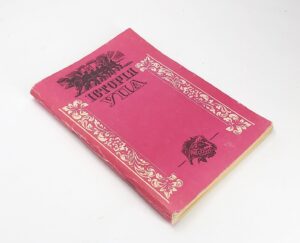
Our book, with its black-and-red wrappers (matching the colours of the UPA) and Ukrainian ornamental floral motives, appears to have been produced either as samizdat or in a very limited print run around the time of the Soviet Union’s collapse. We are aware of a copy with a similar cover design on the same subject matter, titled Istorii UPA [Stories of the UPA], catalogued by the University of Toronto as printed in Ternopil as a commercial book (and not a samizdat per se) by Redaktsiino-vydavnychyi viddil upravlinnia po presi in 1991; however, it comprises only 55 pages (instead of 196 as here) and is authored by the modern historian Yuriy Kyrychuk (1956-2002).
Physical Description
Octavo (20.5 x 14.8 cm). 196 pp. samizdat typescript.
Binding
Original printed and stapled wrappers in pink, black and white, echoing the colours of the UPA.
Condition
Spine creased, a bit chipped at foot; central sheet of notebook loose, pen mark on lower wrapper.






![Image for [SERGEI MIKHAILOVICH ROMANOV]. Sbornik. First edition, Novyi Sad-Belgrade, 1934. #2](https://www.pyrarebooks.com/wp-content/uploads/2025/05/318_1-300x406.jpg)