Our Notes & References
An unusual history of early America, with an early critique of the colonial conquests worldwide, including in Siberia and Alaska, aimed at Russian children, published at the time of the sale of Alaska to the USA.
Rare, especially in publisher’s boards: we could locate only two copies of this edition (Yale, Smithsonian), and one copy of the first, almost identical, 1860 edition (Alaska Rasmusson) in addition to a handful of examples in Russian libraries. No copies of any edition at auctions in the West; in Russia we traced only one other copy of this edition (without original boards) and two examples of the first edition (one incomplete and another washed).
Nicely written for younger readers, the book is divided into four parts: Columbus’s discovery of America, the first Europeans in North America, Vladimir Atlasov’s expedition to Kamchatka and the Kuril Islands, and the history of the Aleutian Islands, told through the voice of an Aleut man.
The preface makes a bold claim for its time: “It turns out that the conquest and discovery of lands everywhere were marked by the same things—unfairness, cruelty, bloodshed, theft. Christopher Columbus in the early 1500s, Vladimir Atlasov in the early 1700s, both discovered unknown lands […] both encountered gentle, humble peoples, and both shed blood on the lands they found. Just as Julius Caesar discovered Gaul and Britain, so Yermak discovered Siberia, the English discovered India, the Spanish Mexico, the Viceroy of Egypt the source of the Nile, and the French Kabylia” (our translation here and below).
The first part, “The Discovery of America and the First Settlements on San Domingo,” recounts Columbus’s early voyages and his crew’s encounters with the paradise-like landscapes and innocent inhabitants of present-day Cuba, the Dominican Republic, and Haiti, resulting in atrocities. The author also notes that America was discovered long before Columbus, in the 11th century by the Vikings, as told in the Vinland Sagas. The following chapter covers later expeditions, including those of John Cabot and Hernando de Soto, whose brutal actions are described in even more graphic detail.
“The Story of the Conquest of Kamchatka” takes on a noticeably more positive tone, despite the preface’s clear criticism of violent subjugations. The Koriaks and Kamchadals — indigenous peoples of Kamchatka and Chukotka — are first portrayed as harmless, but are then accused of attacking the explorers, who allegedly responded with force only after being provoked. Even so, the narrator acknowledges that explorers extorted food and valuables from the locals, and that further conflicts led to sharp population decline: “many industrialists came to Kamchatka and began to oppress the natives by all means, forcing them to hand over valuable furs under the pretext of collecting toll […] this deception so embittered the savages that they began to take revenge on all the newcomers.”
This section contains five chapters, beginning with the first expedition to the Far East led by the Yakut Cossack Luka Semenov Morozko in the late 17th century. The second and larger expedition, led by Atlasov in 1696, included hired Yukaghir people. During this journey, the explorers encountered a captured Japanese man whose accounts led them south towards the Kuril Islands and to the discovery of Cape Lopatka. One chapter focuses on Kamchatka’s rich flora and fauna, the locals’ methods of hunting and fishing, their cuisine, the use of hallucinogenic mushrooms, and clever household tricks—such as how to keep huts warm. The final chapter discusses the 1728 discovery of the Bering Strait, as well as earlier explorations by Semen Dezhnev and Nikita Semenov in the 1650s, driven by “a desire for profit and a passion for an active life.”
The final part introduces a fictional narrator—an Aleutian former sailor—who, as a child, helped his uncle Ivan Shadurov (d. 1820, possibly a real historical figure later mentioned in Russian studies) bring food to Russian explorers hiding from local revenge attacks in the 1760s. After being captured, the boy was sentenced to a ritual death but was rescued by the Russians. His account continues with vivid stories of island life, including detailed descriptions of hunting and fishing. These lead to the conclusion that made the book acceptable to the censor: “[the explorer Ivan] Solovev and the other Aleut exterminator, [Stepan] Glotov, along with all their companions, were uneducated men, and it’s no surprise that they took revenge for their comrades’ deaths far too harshly, killing a great many of my fellow countrymen […] But after we came under the high hand of the Russian Tsar, we began to live quietly and peacefully—far better than before.” The only drawback, the narrator notes, is that “since the Russians arrived, there are fewer animals in our area”—a loss justified by the benefits of economic growth.
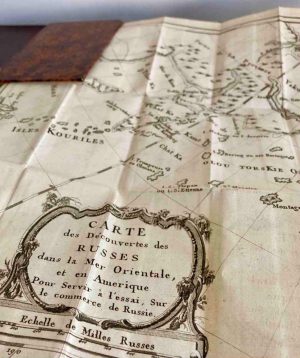
The illustrations include a humorous frontispiece, signed by the artist Mikhail Mikeshin, depicting a walrus-and-bear encounter among drifting ice; an image of Columbus’s three modest ships from his first voyage; a map of Kamchatka with the various peoples marked; and a hunting scene showing locals and Russians together, surrounded by Kamchatka’s impressively tall and varied vegetation. The final plate shows Indigenous people — likely Aleutians — gathering eggs on seaside cliffs.
This copy is preserved in its original bright green (possibly coloured with arsenic-based pigments?) and gold binding, with lace-like frames displaying the title and the name of the children’s book series: Zelenaia biblioteka [Green Library], one of the earliest Russian popular science series for children. It was published by the prominent publisher Mavrikii Volf, founder of the famous Russian geographic magazine Vokrug Sveta [Around the World], which remains in print to this day.
The author, Aleksei Razin (1822–75), was born into a family of former serfs. A schoolteacher by profession, he also worked as a publisher and editor of Zhurnal dlia detei, one of the most successful children’s magazines of the time, and wrote prolifically for children. In 1860, he joined the literary circle of Fedor Dostoevsky, who spoke positively of his work.
Bibliography
Markov, Sergei. Zemnoi krug: kniga o zemleprokhodtsakh i morekhodakh, Sovremennik, 1976.
Physical Description
Octavo (18.3 x 12.5 cm). Half-title, title, 219 pp., with 5 engr. plates on glossy paper.
Binding
Publisher’s green decorative boards with gilt and blind-stamped frames, lettering, and centrepiece vignettes.
Condition
Rebacked preserving original boards, corners restored and rubbed; foxing and light staining throughout, a couple of marginal pencil inscriptions.