Our Notes & References
Georgi’s rare first book, his important account of an Academy of Sciences expedition, including the first detailed descriptions of the Buryats and Tungus (Evenks), the first information about Japan published in Russia, and plates not found in other publications. Published shortly before his celebrated Descriptions of all Nations of the Russian Empire.
An attractive, fresh example of the rare first edition, found in libraries but not on the market, with the last copy traced at auction being in 1992.
Following the conquest of Siberia in the seventeenth century, Russia found herself ruling over an enormous diversity of peoples, including, for the first time, large numbers of Buddhists. Ever the consummate Enlightenment monarch (and by nature something of an Orientalist), Catherine II (r. 1762-1796) wished to understand exactly what had been conquered, and thus funded a series of Academy of Science expeditions between 1768-74. By all accounts these were “the most grandiose scholarly effort(s) undertaken by any European state at that time” (Cvetkovski). However, as there had been no universities in Russia until 1724, the expeditions relied largely on Germans such as Johann Gottlieb Georgi (1729-1802), a talented polymath, being a botanist, naturalist, geographer and ethnographer.
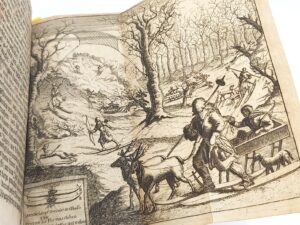
Although originally part of the Pallas expedition, Georgi also planned a different route for his own research, to the areas north of Lake Baikal. There he wrote what are almost certainly the first detailed descriptions of the Samoyeds (Nenets), Ostyaks (Khanty), Voguls (Mansi), Tungus (Evenks) and Buryats. His method was the ethnographic equivalent of Linnaean classification, “naming the world in its entirety” by recording endonyms, exonyms, toponyms, a rudimentary vocabulary, and the names of local gods and spirits (cf. Slezkine). Georgi paid especial attention to the Tungus, “who defended themselves from the colonisers more strongly than other Siberian peoples”. They are featured in one of the six engraved plates, wearing their traditional costumes in the aftermath of a hunt. Other plates include the first ever map of Lake Baikal (see Galazii), local fish and flowers, a map of the town of Ayschi, and the shamanistic effigies of the Buryats. Interestingly, these illustrations were not reproduced anywhere else, including in Georgi’s later publications, and we couldn’t trace any Russian translation of the work.
A botanist by training, Georgi also provided the first descriptions of the region’s flowering plants, many of which became prized as rare specimens in European botanical gardens.
Finally, the book also contains “the first information about Japan published in Russia, obtained directly from the Japanese themselves”, recounted by sailors at the Japanese navigation school in Irkutsk (cf. Shafranovskaia). In a scenario not unlike the Thousand and One Nights, the sailors recount tales of gilded pleasure boats, bountiful harvests and beautiful women.
Food and culinary practices were intrinsically bound up with civilisation for Georgi. Early Siberian travel accounts are full of accusations of savages eating dogs, cats, mice, raw meat, and even their own filth (see Slezkine). It was perhaps due to the institutionalised vegetarianism of the Japanese, as well as their wide range of alcoholic beverages and knowledge of medicinal herbs that Georgi gave them a more complimentary treatment than nearly any other group in the book, calling them “people of capable minds, honesty, diligence and a love of harmony” (p.7).
Georgiʻs research advanced intellectual history and Russia’s understanding of itself. The attention he paid to shamanism and Buddhism was important for those ethnic minorities to achieve the minimal concession that they were not corrupt savages, but did in fact possess “a kind of morality” (Tsyrempilov). Similarly, his study of the enormous human diversity of Siberia led to the realisation that the concept of ‘civilisation’ itself is relative and contingent, and that “until very recently the Russians themselves had been like the Kamchadal” (Slezkine).
Catherine II was very pleased with the results — upon Georgi’s return in 1776 he was made a full member of the Academy of Sciences, and subsequently a professor in chemistry. She is also said to have rewarded Georgi with a golden snuffbox, and later commissioned an elaborate set of tableware and now famous and collectable porcelain figurines translating engravings from Georgi’s books.
Provenance
G. von Salisch (contemp. inscription in ink to title); Staadtarchiv Lengefeld (blue ink stamp to upper fly-leaf).
Bibliography
Cat. Russica G-335. Cvetkovski, Roland, and Alexis Hofmeister. 2014. An Empire of Others: Creating Ethnographic Knowledge in Imperial Russia and the USSR. Central European University Press; Galazii, Grigor Ivanovich. 1987. Baikal v Voprosakh i Otvetakh [Baikal in Questions and Answers]. Vost-Sib Kn. Izd-vo [Eastern Siberian Book Publishers]; Shafranovskaia, T.K. 1972. Iaponia v Seredine XVIII v. Po Soobshcheniiu I. I. Georgi. Vol XIII. Strany i Narody Vostoka [Lands and People of the East]. Akademiia Nauk SSSR [Academy of Sciences USSR]; Shaw, Denis J.B. 2024. Reconnoitring Russia: Mapping, Exploring and Describing Early Modern Russia, 1613-1825. UCL Press; Slezkine, Yuri. 1994. ‘Naturalists Versus Nations: Eighteenth-Century Russian Scholars Confront Ethnic Diversity’. Representations, no. 47: 170–95; Tsyrempilov, N. Noble Paganism: Orientalist Discourse on Tibetan Buddhism in Nineteenth-Century Russian Polemic Literature. Inner Asia 2015, 17 (2), 199–224.
Physical Description
Two volumes in one large 4to (27 x 21 cm). [7] leaves inc. title, 449 pp., 500-506 pp.; title, [507]-920, and 6 plates engraved by S. Maximov. Complete as issued.
Binding
Contemporary German half calf over yellow boards, rounded spine with raised bands, compartments with gilt fleurons and other gilt decorations, two labels with contrasting colours lettered in gilt, red speckled edges.
Condition
Binding lightly rubbed; title with two small drawings or crossed over inscriptions, very occasional marginalia in pencil, a leaf with tear without loss of text, a very fresh example.



![Image for [BAIRD] The St. Petersburg Steamboat. Large lithograph before the letter, contemporary hand-colour. 1830s #2](https://www.pyrarebooks.com/wp-content/uploads/2026/02/1925_1-300x205.jpg)